

For many of us, this time of year brings both joy and stress. While holiday gatherings can help us reconnect with loved ones, they can also lead to tension, old patterns, and hurt feelings. However, with the right tools and mindset, it is possible to navigate these challenging relationships with greater confidence and ease. If you’re anticipating challenging interactions, you are not alone. Here are some tips you may use this season if you are feeling anxious about upcoming interactions.
Start With Clear, Compassionate Boundaries
At any time of year you are allowed to set limits on what you are and are not comfortable with, even if others don’t understand them. Setting clear, compassionate boundaries during the holidays is an essential act of self-care, and it doesn’t matter if others don’t fully agree with them. Boundaries can take many forms—limiting how long you stay at gatherings, steering conversations away from topics that feel uncomfortable, or reminding yourself that you do not have to carry the weight of someone else’s emotions or expectations. By communicating these limits calmly and confidently, you protect your emotional well-being while still showing respect for others.
Using “I” statements—such as “I need to head out after two hours,” “I’m choosing not to discuss that today,” or “I won’t be able to take that on right now”—helps reduce defensiveness and reinforces your right to make choices that support your mental health.
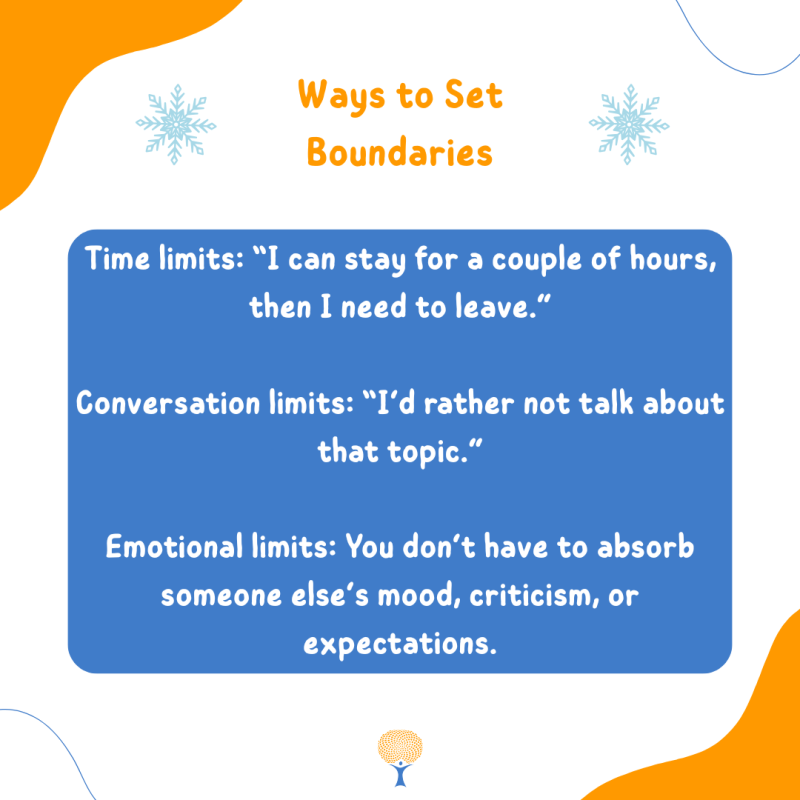
Ways to set boundaries:
- Time limits: “I can stay for a couple of hours, then I need to leave.”
- Conversation limits: “I’d rather not talk about that topic.”
- Emotional limits: You don’t have to absorb someone else’s mood, criticism, or expectations.
Protect Your Mental Health With “Micro Breaks”
Holiday gatherings can be emotionally and mentally overwhelming, especially when you’re navigating complicated family dynamics, crowded spaces, or constant social demands. Research shows that even taking very short breaks – micro breaks of just a few minutes – can significantly reduce stress and fatigue and boost feelings of vigour (Albulescu et al, 2022). Building in “micro breaks” is a simple yet powerful way to stay grounded and protect your mental health throughout the season.
These are short, intentional pauses that allow you to reset your nervous system before stress escalates. A micro break can be as small as stepping outside for a few minutes of fresh air, taking a quiet moment in the bathroom to breathe deeply, or offering to run a quick errand so you can regroup (Dey, 2025). Even a short walk around the block, stretching in a private corner, or checking in with a supportive friend over text can help you return to the moment with more clarity and stability (Packer, 2021)
The goal isn’t to disappear from the gathering but to give yourself space to regulate your emotions and avoid becoming overwhelmed. Micro breaks help you reconnect with yourself, reduce tension, and prevent the emotional buildup that can lead to exhaustion, irritability, or anxiety. They act as pressure valves, allowing you to stay present without sacrificing your well-being. By planning and permitting yourself to step away as needed, you create a more manageable and emotionally safe holiday experience.
Examples:
- Step outside for fresh air
- Offer to “run to the store”
- Go to the bathroom and breathe for 60 seconds
- Take a brief walk
- Text a friend or support line for grounding
These intentional pauses keep you regulated and prevent overwhelmed feelings.
Prioritize Healthy, Reciprocal Relationships
You do not owe equal emotional access to everyone just because you share DNA or history. Prioritizing healthy, reciprocal relationships during the holidays means giving your time, energy, and emotional presence to the people who genuinely support your well-being—not simply those connected to you by feelings of obligation or family ties. You are not required to offer the same level of emotional access to everyone, especially if certain relationships consistently drain you, dismiss your boundaries, or leave you feeling unseen.
Healthy relationships are built on mutual respect, care, and emotional safety, and the holidays are an ideal time to lean into those connections that feel nourishing and supportive. This might mean spending more time with friends who understand you, choosing smaller gatherings that feel more stable, or limiting interactions with individuals who repeatedly trigger stress or discomfort. By intentionally centring the relationships that lift you—not the ones that weigh you down—you protect your emotional health and create a holiday experience grounded in genuine connection rather than obligation.
Lean toward people who:
- Respect your boundaries
- Make you feel emotionally safe
- Don’t guilt-trip you
- Allow you to be your authentic self
Lean away from people who:
- Drain you
- Criticize or belittle you
- Only value you for what you give
- Dismiss your feelings
It’s okay to choose your “found family” during the holidays. (Thomas et al., 2017; Horwitz et al., 2014).
Release Guilt — It’s Not Evidence That You’re Wrong
Guilt often shows up when we start doing things differently. That doesn’t mean you’re making the wrong choice — it means you’re breaking old patterns. Guilt may surface when we begin making choices that challenge old expectations, family roles, or longstanding patterns of behaviour. It’s a deeply human response, but it isn’t proof that you’re doing something you shouldn’t—it’s simply a sign that you’re stepping out of familiar dynamics and into healthier ones.
When you start prioritizing your mental health, setting boundaries, or choosing peace over obligation, guilt may try to pull you back into what’s comfortable, even if that comfort has come at your own expense. Instead of treating guilt as a stop sign, try viewing it as an indicator of growth. You’re allowed to outgrow versions of yourself that once kept the peace at your own cost, and you’re allowed to choose actions that support your well-being—even when it feels uncomfortable at first. Over time, that guilt fades, and what takes its place is clarity, confidence, and a deeper sense of self-respect (Strauss Cohen Ph.D., 2017).
Remember:
- Caring for your mental health is NOT selfish
- Protecting your peace is not unkind
- You’re allowed to change the “usual” Christmas routine
- You don’t have to make everyone happy — that’s impossible anyway
Guilt fades; resentment grows. Choose the option that supports your long-term well-being.
Have a Plan for Difficult People
If you anticipate harmful comments or conflict, go in prepared. Having a plan for navigating difficult people during the holidays can help you stay grounded and reduce the likelihood of getting pulled into conflict or emotional discomfort. If you anticipate harmful comments, boundary-pushing, or old patterns resurfacing, preparing ahead of time gives you a sense of control and calm.
This might include scripting a few neutral responses—such as “I’m not getting into that today,” “Let’s change the subject,” or “I need to step away for a moment”—so you’re not caught off guard in the moment. It can also be helpful to identify your personal triggers and plan how you’ll respond if they arise, whether that’s taking a breath, removing yourself, or redirecting the conversation. Having an exit strategy, such as deciding how long you’ll stay or setting up a check-in with a friend for support, can further protect your emotional well-being. The goal isn’t to control others but to empower yourself with tools that support your peace, even when someone else chooses not to respect it (Gather & Ground Wellness – Vancouver Counselling Clinic Conflict, 2024).
Try this:
- Script short responses:
“Hmm, I don’t agree, but I’m not getting into that today.”
“Let’s change the subject.”
“I’m stepping away for a moment.” - Identify triggers ahead of time so you’re not blindsided.
- Establish your exit strategy — how long you plan to stay and when you’ll leave if needed.
Permit Yourself to Say No
The pressure to attend everything can be intense. Saying no during the holidays is one of the most powerful ways to protect your mental and emotional well-being, yet it can also feel like one of the hardest. The pressure to attend every event, contribute to every gathering, or meet everyone’s expectations can become overwhelming. Many people feel obligated to say yes out of fear of disappointing others, disrupting tradition, or being perceived as unkind. The truth is that you are allowed to honour your capacity, and you are allowed to decline requests that don’t align with your needs, energy, or circumstances. Permitting yourself to say no is an essential part of healthy boundary-setting, and doing so helps you show up more authentically in the commitments you do choose.
A “no” doesn’t need to be dramatic, detailed, or defensive. In fact, keeping it simple is often the most respectful and effective approach. Statements like, “I’m not up for hosting this year,” “I can’t make it, but I hope you have a wonderful time,” or “That doesn’t work for me this holiday season,” are clear, kind, and direct. They communicate your decision without inviting negotiation or requiring justification. The more you practice short, polite boundaries, the more natural they will feel, and the easier it becomes to recognize when a request exceeds your emotional or physical bandwidth.
Saying no also creates space for what does matter—rest, meaningful connections, and traditions that genuinely bring you joy. It allows you to conserve energy rather than stretching yourself so thin that the holidays become a source of exhaustion rather than comfort. Remember that your needs are just as important as anyone else’s and choosing not to attend an event does not make you selfish; it makes you self-aware. When you permit yourself to decline, you are prioritizing your well-being, creating healthier relational patterns, and ensuring that you enter the season with more peace, intention, and emotional balance (Germain, 1022).
Create New Traditions That Feel Safe and Supportive
If the old traditions cause stress or emotional pain, you’re allowed to reinvent Christmas. Creating new holiday traditions can help reduce stress and promote emotional safety by offering a sense of purpose, predictability, and connection. Not every family ritual has to be maintained if it triggers anxiety, conflict, or emotional pain; you are allowed to reinvent Christmas in a way that nurtures your well-being. New traditions might include quiet mornings spent reading or enjoying coffee, small dinners with close friends, volunteering for causes you care about, or even dedicating a day entirely to self-care and reflection. The focus is on creating experiences that bring joy, connection, and peace rather than obligation.
Reinventing traditions doesn’t mean abandoning the holiday spirit; it means prioritizing emotional safety and authenticity. By intentionally crafting rituals that resonate with your current values and needs, you provide yourself and your loved ones with meaningful, memorable experiences without the burden of guilt or overcommitment. Over time, these new traditions can become cherished routines that balance celebration with emotional well-being, demonstrating that the holidays can be both joyful and restorative, rather than stressful or triggering. Embracing this flexibility allows you to step into the season on your own terms, creating a sense of empowerment and control while still honouring the spirit of the holidays (Anderson, 2023).
New traditions might include:
- A quiet morning alone with coffee
- A dinner with friends
- Volunteering
- A movie day
- A self-care day with no obligations
- A “chosen family” celebration (CMHA Offers 15 Tips for Holiday Peace of Mind and Coping with Holiday Grief – CMHA British Columbia, 2016)
Give Yourself Debrief Time Afterward
Giving yourself debrief time after social events is a key strategy for maintaining emotional balance and protecting mental health, especially during the holidays when gatherings can be emotionally intense or overstimulating. A debrief allows you to process your experiences, release residual stress, and regain a sense of calm before moving on to the next obligation. This time can be used for grounding activities such as journaling, reflecting quietly, taking a warm bath, practicing mindfulness or meditation, going for a walk, or engaging in a comforting hobby. Even short pauses—just 10 to 15 minutes or a micro break—can help you reset emotionally and physically, reducing tension and preventing overwhelm.
Debriefing also helps you notice patterns in your social interactions: which conversations were draining, which moments brought joy, and where boundaries could be reinforced in the future. By reflecting thoughtfully, you can plan ahead for subsequent gatherings with greater clarity and confidence. Additionally, giving yourself this time normalizes self-care as part of your holiday routine, reinforcing the idea that your well-being matters just as much as maintaining social traditions. Ultimately, post-event debriefing is not a luxury—it is a practical tool for sustaining emotional resilience, increasing self-awareness, and creating a holiday experience that feels both meaningful and manageable (Klibert et al, 2022).
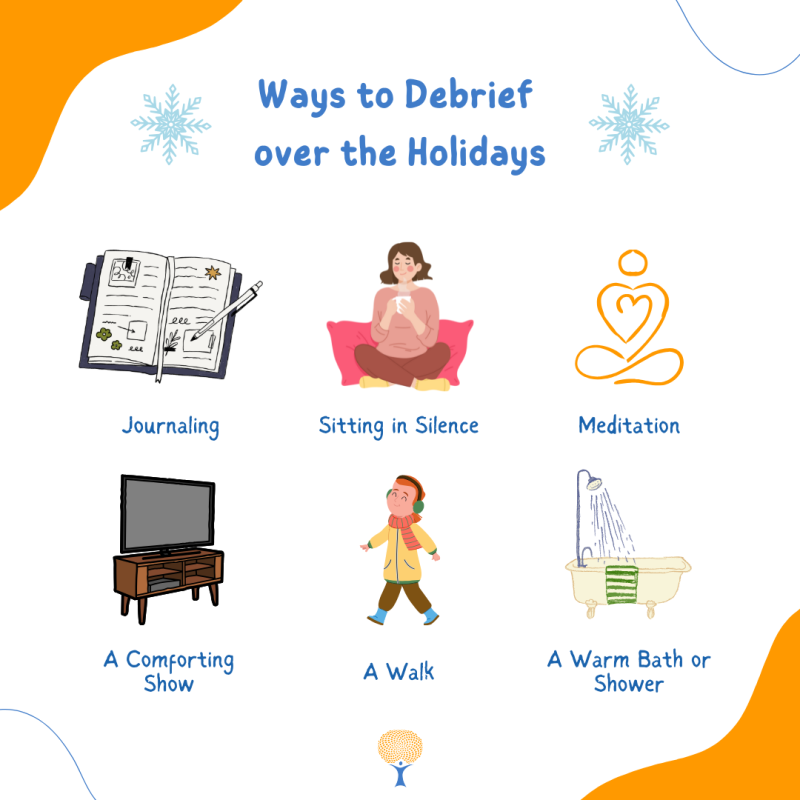
After social events, do something grounding:
- Journaling
- Sitting in silence
- A warm bath or shower
- A comforting TV show
- A walk
- Meditation
- A conversation with a trusted person
Let your nervous system reset.
Remember: You Can Love People From a Distance
You can care deeply about others while still setting boundaries that protect your emotional well-being. Limiting your interactions doesn’t mean you are unkind or indifferent; it reflects a conscious choice to preserve your mental and emotional health. You can genuinely wish someone well without allowing them unlimited access to your time, energy, or emotions. It is possible to remain polite and respectful while keeping a safe emotional distance.
Creating space between yourself and others can be an act of self-respect, indicating that your needs and limits matter. Establishing boundaries does not lessen your compassion; rather, it allows you to engage more fully and authentically in healthy, reciprocal relationships while reducing exposure to interactions that drain or harm you. Recognizing that distance can be a form of self-care empowers you to navigate your relationships intentionally, honor your limits, and foster meaningful connections on your own terms.
It’s important to remember that loving someone doesn’t require sacrificing your well-being and that protecting yourself is both reasonable and necessary.
Distance can be an act of self-respect.
Offer Yourself Grace
The holidays amplify emotions. It’s normal to feel:
- Pulled in many directions
- Triggered by past family patterns
- Guilty for choosing yourself
- Exhausted after events
- Pressure to meet others’ demands
There is nothing wrong with you if you feel anxious about the upcoming holiday season — it’s a complex time of year.
Conclusion
The holiday season can be a time of joy, connection, and celebration, but it also often brings heightened stress, emotional triggers, and challenging relationships. By setting clear boundaries, protecting your mental health, prioritizing reciprocal relationships, and giving yourself permission to say no or reinvent traditions, you create space for a healthier, more intentional holiday experience. Grounding practices, debriefing after social events, and recognizing the value of emotional distance allow you to navigate gatherings with greater calm, clarity, and self-respect. Ultimately, prioritizing your well-being does not diminish your care for others—it strengthens your capacity to engage authentically, compassionately, and sustainably. Embracing these strategies empowers you to transform the holidays into a season that honours both connection and personal peace, ensuring that the celebrations you participate in nourish your mind, body, and spirit.
Additional Resources
- Ontario Suicide Prevention Roundtable – www.SuicidePreventionOntario.ca
- Delgado Lab – Emotion Regulation Under Stress: Social Processing & Memory
This research highlights how reflecting on social relationships and autobiographical memories supports emotional regulation after stressful events – 7854_2024_560.pdf - Frontiers in Psychology — Savouring Interventions to Increase Positive Emotions After Social Stress
A study showing that using “savouring” (focusing on positive moments) after a socially stressful event can boost positive emotions and reduce physiological stress. – Frontiers | Savoring Interventions Increase Positive Emotions After a Social-Evaluative Hassle - Mental Health Commission of Canada – www.MentalHealthCommission.ca
- Heartache2Hope – https://heartache2hope.com/
- November Blog on Holiday Self-Care – https://www.dcontario.org/self-care-during-the-holiday-season/
Recommended Books (for deeper learning)
- Set Boundaries, Find Peace by Nedra Glover Tawwab — a practical, accessible guide to setting limits compassionately.
- Drama Free by Nedra Glover Tawwab — focused on boundary-setting in family systems.
- The Dance of Anger by Harriet Lerner — explores entrenched family dynamics and improving communication.
References
Albulescu P, Macsinga I, Rusu A, Sulea C, Bodnaru A, Tulbure BT (2022), “Give me a break!” A systematic review and meta-analysis on the efficacy of micro-breaks for increasing well-being and performance. PLoS One. 2022 Aug 31;17(8):e0272460. doi: 10.1371/journal.pone.0272460. PMID: 36044424; PMCID: PMC9432722
Anderson, R. (2023, November 21). Mental health and wellness during the holidays. WISE Initiative for Stigma Elimination. Mental Health and Wellness During the Holidays – WISE Initiative for Stigma Elimination
CMHA Offers 15 Tips for Holiday Peace of Mind and Coping with Holiday Grief – CMHA British Columbia. (2016, July 19). CMHA British Columbia. https://bc.cmha.ca/news/cmha-offers-15-tips-for-holiday-peace-of-mind-and-coping-with-holiday-grief
Dey, A. (2025, August 2). Microbreak is the answer to employee fatigue: 5 benefits that are game-changers for productivity | Health. Hindustan Times. https://www.hindustantimes.com/lifestyle/health/microbreak-is-the-answer-to-employee-fatigue-5-benefits-that-are-game-changer-for-productivity-101754137134548
Gather & Ground Wellness – Vancouver Counselling ClinicConflict. (2024, December). Gather & Ground | Vancouver Relationship Counselling , Anxiety, Trauma Therapy. https://www.gatherandground.ca/blog-counselling-resources-mental-health/managing-family-conflict-during-the-holidays
Germain, D. (1022, July 7). Setting your boundaries for the sake of your mental health | Beneva. Www.beneva.ca. https://www.beneva.ca/en/blog/health/setting-boundaries-mental-health
Horwitz, B. n., Reynolds, c. a., & Charles, s. t. (2014). Understanding associations among family support, friend support, and psychological distress. Personal Relationships, 22(1), 79–91. https://doi.org/10.1111/pere.12063
Klibert, J. J., Sturz, B. R., Hatton, A., Smalley, K. B., & Warren, J. C. (2022). Savoring Interventions Increase Positive Emotions After a Social-Evaluative Hassle. Frontiers in Psychology, 13, 791040. https://doi.org/10.3389/fpsyg.2022.791040
Packer, J. (2021). Taking a break: Exploring the restorative benefits of short breaks and vacations. Annals of Tourism Research Empirical Insights, 2(1), 100006. https://doi.org/10.1016/j.annale.2020.100006
Strauss Cohen Ph.D., I. (2017). When Guilt Keeps You From Setting Boundaries. Psychology Today. https://www.psychologytoday.com/ca/blog/your-emotional-meter/201705/when-guilt-keeps-you-setting-boundaries?utm_source=chatgpt.com Thomas, P. A., Liu, H., & Umberson, D. (2017). Family Relationships and Well-Being. Innovation in Aging, 1(3), 1–11. https://doi.org/10.1093/geroni/igx025